
Last updated
How Many Restrooms Does a County Fair Need?
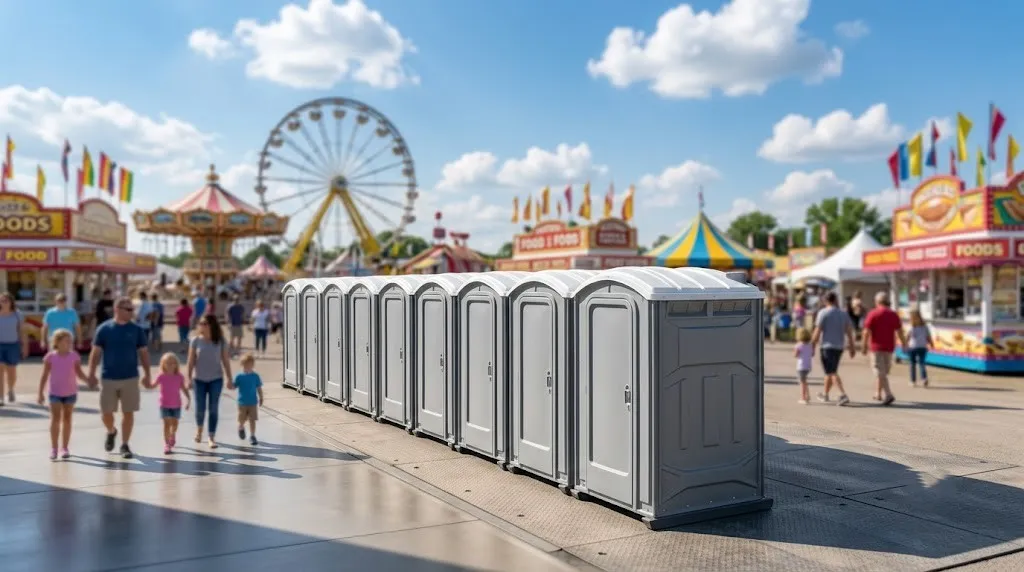
Start with attendance, then add units for food courts, livestock areas and anywhere lines form fast. A fair pulling a few thousand people over a weekend needs more than a construction crew of the same size, because everyone shows up in the same four-hour window instead of trickling in over a shift. OSHA 1926.51(c)(1) sets construction ratios at 1 toilet per 20 workers up to 20 people, then 1 toilet and 1 urinal per 40 workers above that. Fairs aren't job sites, but the same logic applies: crowd density drives the count more than the acre count does. For a fairgrounds layout, we usually spread standard portable toilets across the grounds in clusters near the midway, the grandstand and the vendor rows, rather than one bank of units in a single corner. If you're not sure where to start, our placement guide walks through sightlines, generator noise and foot traffic patterns, and the how many porta potties do I need page runs the math per guest count. Accessible units matter here too. Under ADA Standards section 213.2, where single-user units are clustered, at least 5 percent must be accessible, with a minimum of one no matter how small the cluster. We build that into every fair quote so nobody's turned away at the gate.
What Restroom Options Work Best for a Fair Crowd?
Standard units cover the midway and parking lots, but a fair pulling a real crowd usually mixes in something nicer for VIP areas, sponsor tents or the grandstand. A 4 stall restroom trailer or 8 stall restroom trailer keeps lines moving for a big weekend crowd, with flushing fixtures and running water instead of a holding tank setup. For sponsor hospitality or a beer garden that runs late, a luxury restroom trailer reads a lot better than a row of blue boxes. Deluxe flushable units split the difference: still a standalone unit, but with a flush handle and a sink, which matters when your fair runs past dark and the porta potties are getting heavy use all day. Every unit on site, standard or trailer, needs handwashing nearby. 29 CFR 1910.141(d)(2) requires soap and towels or a hand dryer at washing stations, and hand sanitizer alone doesn't satisfy it, so we pair handwashing station rentals or portable sink rental units with every restroom cluster, not just the food vendors. If your fair has a livestock barn or 4-H area, that's really a farm and agricultural restrooms situation layered onto the main event, and it usually needs its own water source and wash station near the animal pens.
Where Should Restrooms Go on the Fairgrounds?
Placement decides whether your restrooms work or become the thing everyone complains about. Units need level, stable ground. ADA Standards section 302.1 requires floor and ground surfaces to be stable, firm and slip resistant, which rules out loose gravel or soft turf for accessible units without a mat or pad underneath. Keep a clear path at least 36 inches wide to every unit, per ADA Standards section 403.5.1, and don't let vendor tents or fence lines pinch that route down. If you're renting a restroom trailer, plan on roughly 60 feet of straight clearance for delivery, similar to what a roll-off truck needs, so check your gate width and access road before delivery day. Temporary fencing around restroom clusters helps with crowd flow and keeps the units from becoming a shortcut through a closed area, and temporary fence rental or crowd control barrier rental both do that job depending on how formal the boundary needs to be. Fairgrounds outside Laredo proper, out toward Los Corralitos about 8.3 miles northwest or the cluster of communities near Los Altos roughly 11.7 miles southeast, sometimes fall under different placement rules for the public right of way, so that's worth confirming with the city or county before you finalize your site map.
| unit | day | week |
|---|---|---|
| standard | $100-$350 | $130-$500 |
| deluxe | $85-$1,200 | $150-$290 |
| ada | $200-$400 | $240 and up |
Multi-day fairs often land closer to the event rate, which we quote separately since attendance and duration both move the number. See porta potty rental cost for how these bands break down, or request a quote with your dates and headcount.
How far in advance should we book fair restrooms?
Book as soon as your date and headcount are set, ideally 4 to 6 weeks out for a multi-day fair. Fairground season fills delivery slots fast in Laredo, and trailers especially need lead time for routing and setup checks.
Do you service units during a multi-day fair?
Yes. Multi-day fairs get servicing scheduled into the quote, typically once daily for high-traffic clusters. Tell us your daily attendance pattern and we'll set a service window that doesn't collide with gate hours or the midway rush.
Can we mix standard units and a restroom trailer?
Yes, and most fairs do. Standard units cover the midway and lots; a trailer serves VIP tents, the grandstand, or a beer garden. We size each cluster separately based on where the crowd actually stands.
What if our fairgrounds site has no water hookup?
No problem. Standard and deluxe units are self-contained with their own holding tanks. Restroom trailers need either a hookup or a water tank fill, which we arrange as part of delivery.
Are accessible units required for a county fair?
Yes, if you're clustering single-user units. ADA Standards section 213.2 requires at least 5 percent accessible, minimum one, in any cluster. We build that ratio into the layout automatically on every fair quote.
Next step
Get a delivery date
Tell us the address, the dates and the headcount. We size the order and confirm the route.